

The most significant new development in the politics of American religion this year might turn out to be the high number of white mainline Protestant pastors who are running for Congress as Democrats.
Earlier this year, I wrote an analysis of the mainline Protestant faith of James Talarico, the Austin seminarian running in Texas for the US Senate. But since then, I have learned of several other mainline Protestant Democratic congressional candidates who are not just seminarians or devout church members but active pastors. Adam Hamilton, pastor of the nation’s largest United Methodist Church, is running for a US Senate seat in Kansas. Presbyterian pastor Lindsay James and ELCA minister Sarah Trone Garriott are running for US House seats in Iowa.
While most of these campaigns seemed like longshot bids only a few weeks ago, the latest polls suggest that at least some of these Democratic challengers could win. If that happens, it will be a significant development not only for the Democratic Party but also for mainline Protestantism, which hasn’t had a pastor in Congress in decades.
Mainline Protestant laity, of course, have been serving in Congress as long as there have been mainline Protestant denominations in the United States. If mainline Protestants are defined as members of established, theologically liberal or moderate Protestant denominations such as the United Church of Christ, the Episcopal Church, the United Methodist Church, the Evangelical Lutheran Church of America, the Presbyterian Church (USA), the American Baptist Churches USA, and the Disciples of Christ – which is the way most surveys define the term – one could say that the vast majority of presidents, from George Washington to Donald Trump, have either been lifelong mainline Protestants or have at least passed through the tradition at some point (as Trump did when he attended RCA and PC(USA) churches before identifying as a nondenominational evangelical). And if that has been true of US presidents, it has also been true of members of Congress.
But that’s the laity, not the clergy. For years, white mainline Protestant pastors have engaged in political lobbying and community organizing, and they have often participated in political demonstrations. But they have rarely run for Congress, at least in recent years. Some Protestant pastors served in Congress in the early republic, but in recent decades, mainline Protestant pastors have been less likely to run for Congress than either African American ministers or ordained evangelicals.
The contrast with African American pastors is particularly striking, because African American ministers have been serving in Congress for many years. Adam Clayton Powell Jr., the second African American elected to Congress in the twentieth century, was pastor of New York’s Abyssinian Baptist Church. Years later, John Lewis, an ordained Baptist minister, was elected to Congress after already winning national recognition as a civil rights activist. In the last decade, the list of African American ordained ministers serving in the House has included two Missouri Democrats, Emmanuel Cleaver (D-MO) and Cori Bush (D-MO). But the most prominent African American ordained minister currently serving in Congress is Raphael Warnock, who has continued to serve as pastor of Ebenezer Baptist Church while also representing Georgia in the US Senate.
White evangelical ordained ministers serving in Congress are a more recent phenomenon, but in the last few years, the list has included Senator James Lankford (R-OK), Representative Jody Hice (R-GA), and Representative Mark Harris (R-NC) – all of whom were ordained in the Southern Baptist Convention and all of whom are Republicans.
Yet ordained white mainline Protestants serving in Congress have been much rarer in the last few decades. John Danforth, a moderate Republican and an Episcopal priest who represented Missouri in the US Senate from 1976 to 1995, may have been the last white ordained minister from a mainline denomination to serve in Congress. Although a few (such as Bryan Berghoef, a UCC pastor who ran as a Democratic candidate for a west Michigan congressional seat in 2020) have run for Congress in recent years, they have not won.
But this year, with an unusually high number of mainline Protestant pastors running competitive races as Democratic candidates, it’s easy to imagine that at least some of them will win. And if that happens, it could change mainline Protestantism.
How Will This Moment Change Mainline Protestantism?
As I noted in a recent piece for the Philadelphia Inquirer, mainline Protestant pastors who support legal abortion and LGBTQ+ rights (and who disagree with the Christian Right on multiple other points) are not likely to win over many white evangelical voters. But they are much more likely to rehabilitate the Protestant mainline.
Mainline Protestantism has experienced alarming membership declines in the last fifty years, and those declines are accelerating. The percentage of American adults who were mainline Protestants dropped from 51 percent in the late 1950s to 31 percent in 1975 to 18 percent in 2007 and then to only 11.5 percent in 2024, according to Pew’s Religious Landscape study and Ryan Burge’s data analysis. The decline among regular churchgoers was even more pronounced; by 2016, mainline Protestants who said they attended church nearly every week or more were less than 3 percent of the population.
Given this, it’s not too surprising that some people imagine that mainline Protestantism could disappear entirely. In 2017, Ed Stetzer, executive director of the Billy Graham Center at Wheaton College, used data-based calculations to show that if mainline Protestantism remained on its current trajectory of membership decline, it would essentially disappear by 2039. “If It Doesn’t Stem Its Decline, Mainline Protestantism Has Just 23 Easters Left,” the Washington Post headline reporting Stetzer’s findings proclaimed.
But American denominational traditions almost never entirely disappear. They merge or reinvent themselves, but they don’t just go away. (And to be fair to Stetzer, he actually did suggest that mainline Protestantism might retool and reinvent itself rather than just blithely fade away into oblivion).
In fact, mainline Protestantism has reinvented itself several times in the past. Two of the nation’s most prominent mainline Protestant denominations – the Episcopal Church and the Congregationalist Church (a predecessor of today’s United Church of Christ) – were once established state churches that exercised near-monopoly status on religious options in the colonies that gave them state financial support. That’s one of the main reasons that 15 percent of all American congregations were Episcopal (or Anglican) churches in 1776, and 21 percent were Congregationalist (according to Roger Finke and Rodney Stark’s The Churching of America). In Massachusetts, Congregationalism was the default option for most residents, with the state government collecting taxes to pay Congregationalist ministers. The same was true of the Anglican or Episcopal Church in Virginia.
After state religious disestablishment in the new republic, many Americans decided to switch to some of the new evangelical denominations – especially Methodist and Baptist churches – instead of going to the Episcopal or Congregational church, and as a result, the old establishment churches experienced a massive decline from which they never fully recovered. By 1850, the Congregationalist and Episcopal churches each accounted for no more than 4 percent of the religious adherents in the United States.
It might have been easy for a hypothetical statistician in 1850 to imagine that both the Episcopal and Congregationalist churches would soon fade into oblivion after that massive decline. But if they had predicted that, they would have been wrong. The Episcopal and Congregationalist churches both reinvented themselves as smaller, more elite – and arguably, more intellectually influential – traditions. Instead of being the default option for the masses in particular regions, they instead became upper-crust bastions of cultural influence whose intellectual and political reach vastly outstripped their small membership numbers.
In the 1850s, a Congregationalist (Harriet Beecher Stowe who was the daughter of a minister and wife of a theology professor) wrote the bestselling novel of the nineteenth century. In the early twentieth century, Congregationalists, led by ministers such as Washington Gladden, played a leading role in creating and popularizing the Social Gospel. And as part of the United Church of Christ, Congregationalists continued to spearhead nationally influential social justice projects, with civil rights and antiwar ministers such as William Sloane Coffin and Andrew Young getting ordained in the UCC. Barack Obama came to faith in a historically Black UCC congregation and remained affiliated with it until his 2008 presidential campaign.
Likewise, the Episcopal Church, despite its relatively small size, remained disproportionately popular among more educated or wealthier members of the population. Franklin D. Roosevelt and George H. W. Bush were both lifelong Episcopalians. Leading Episcopal ministers who shaped liberal Protestantism well beyond their own denomination included, among many others, the late 19th-century Boston rector Phillips Brooks and the late 20th-century civil rights activist Pauli Murray.
Similarly, the Methodist Church has evolved from a rapidly growing, fervent (but less educated) frontier denomination in the early 19th century to an established, mainstream, moderately conservative (but socially concerned) denomination that was the nation’s largest Protestant denomination in the late 19th and early 20th centuries, and then to a more ecumenical mainline Protestant denomination in the late 20th century. The Disciples of Christ evolved even more quickly from a revivalist frontier denomination of the Second Great Awakening to a leader in the mainline ecumenical movement in the early 20th century.
All of the denominations in the mainline have shifted identity pretty radically at various points in the past. So, the real question is not whether these denominations will disappear, but rather, how they will evolve and adapt to changing conditions.
I think that the most likely answer is that they will find a way to survive as small progressive denominations that become leaders in a revived Religious Left.
Mainline Protestant pastors lean pretty strongly toward political liberalism, and have for several decades. A 2022 PRRI study found that among mainline Protestant clergy, Democrats outnumber Republicans by more than three to one. Clergy from the UCC, the PC(USA), ELCA, and Episcopal churches are particularly likely to favor progressive politics; more than two-thirds of the pastors in each of these denominations describe themselves as political liberals.
Yet most mainline Protestant lay churchgoers do not lean toward the political left. Republicans outnumber Democrats among white mainline Protestants who regularly attend church. And self-identified conservatives outnumber self-described liberals by more than two to one.
The problem that mainline Protestant clergy face is that their churches don’t match their denominational brands. If you read the denominational resolutions of a mainline Protestant denomination such as the UCC or the PC(USA), you would get the impression that it’s a highly progressive denomination that is fully in sync with the Democratic Party (or maybe even the party’s most progressive wing). For years, mainline denominations such as the PC(USA) and UCC have lobbied for Palestinian rights, affirmed LGBTQ+ and abortion rights, and positioned themselves as leading voices for racial equality, peace, anti-poverty initiatives, and the rights of immigrants. Mainline Protestant clergy have put their bodies on the line to stop ICE raids and protect undocumented immigrants from deportation. They have been a prominent presence at antiwar marches.
But their churches are filled with (mostly older) people who vote Republican. And with only a few rare exceptions, most of their church services are pretty staid and their sermons generally uncontroversial – which is why lifelong Republicans are comfortable there, despite the political liberalism of the pastors.
This odd discrepancy between the political theology of the pastors or the denomination and the political leaning of the congregants has perhaps prevented mainline Protestant churches from filling what may be the most conspicuous religious vacuum in contemporary America: the dearth of organized religion among young and middle-aged white Democrats. In 2024, 73 percent of white Democrats said they went to church or other religious services less than once a year. And that’s all white Democrats, regardless of age. Democrats in their 20s and 30s are only about half as likely to attend church as Democrats over the age of 75.
Why Democrats who came of age after the late 1960s were much less likely than their conservative peers to attend church has not yet been satisfactorily answered – but regardless of the cause, this phenomenon has had a severe impact on mainline Protestantism. To reverse their membership decline, mainline Protestants need to find a way to appeal to younger people (or really, appeal to anyone younger than retirement age) who are politically progressive and currently unchurched. In other words, they need to project an image that is in keeping with the political viewpoints that their pastors already hold, but that most of their church members do not.
I suspect that if James Talarico’s Senate campaign is successful, and that if he is joined in Congress by a few other mainline Protestant clergy who are Democrats, this will likely be an important first step in rehabilitating the cultural image of mainline Protestantism for a younger generation of progressives.
If people begin to think of mainline Protestant pastors as advocates for the social justice causes they care about, they’ll begin to think of mainline Protestant churches not as bastions of Republicans or as country clubs for the elderly, but instead as progressive social justice advocacy organizations whose leaders are campaigning for Democratic Party initiatives in Congress.
I could be wrong about all of this, of course. The future of American religion is notoriously difficult to predict, which is why historians in the field are often as surprised as the general public when religious demographics change in unforeseen ways.
But given American denominations’ centuries-long record of successful change and adaptation, I think that I’m on pretty solid ground in predicting that mainline Protestant denominations are more likely to find a way to reverse their long-term decline than to simply disappear. Given mainline Protestant clergy’s decades-long (and increasing) identification with the Democratic Party and political liberalism, I think that I’m on fairly safe ground in suggesting that there’s a good chance that they will try to reorient their congregations’ public image to reflect their denominations’ stated political ideals. And given the record number of mainline Protestant clergy running for Congress this year, I think that I may be right in suggesting that if several of these candidates win, they’ll not only make the Democratic Party look less secular but they’ll also make their own churches look less conservative. And that, in turn, might be the first step in attracting Democrats and progressives to their congregations.
After all, the secularization of the Democratic Party is a very recent phenomenon. Forty years ago, there were a lot of highly religious white Democrats, as well as strongly churched African Americans, and some of those churched people identified as liberals or progressives. If liberal Democrats were comfortable going to church and identifying as Christians in the 1980s, there’s no intrinsic reason to automatically assume that a liberal mainline church couldn’t attract them today.
If mainline Protestant churches can attract even a small percentage of the Democratic “nones,” it will go a long way toward changing the public image of both the Democratic Party and mainline Protestantism. Perhaps the midterm elections this year will help them do that – at least if some of the clergy who are running for Congress win their races.
Daniel K. Williams is an associate professor of history at Ashland University and the author of The Search for a Rational Faith: Reason and Belief in the History of American Christianity (Oxford University Press, 2026).
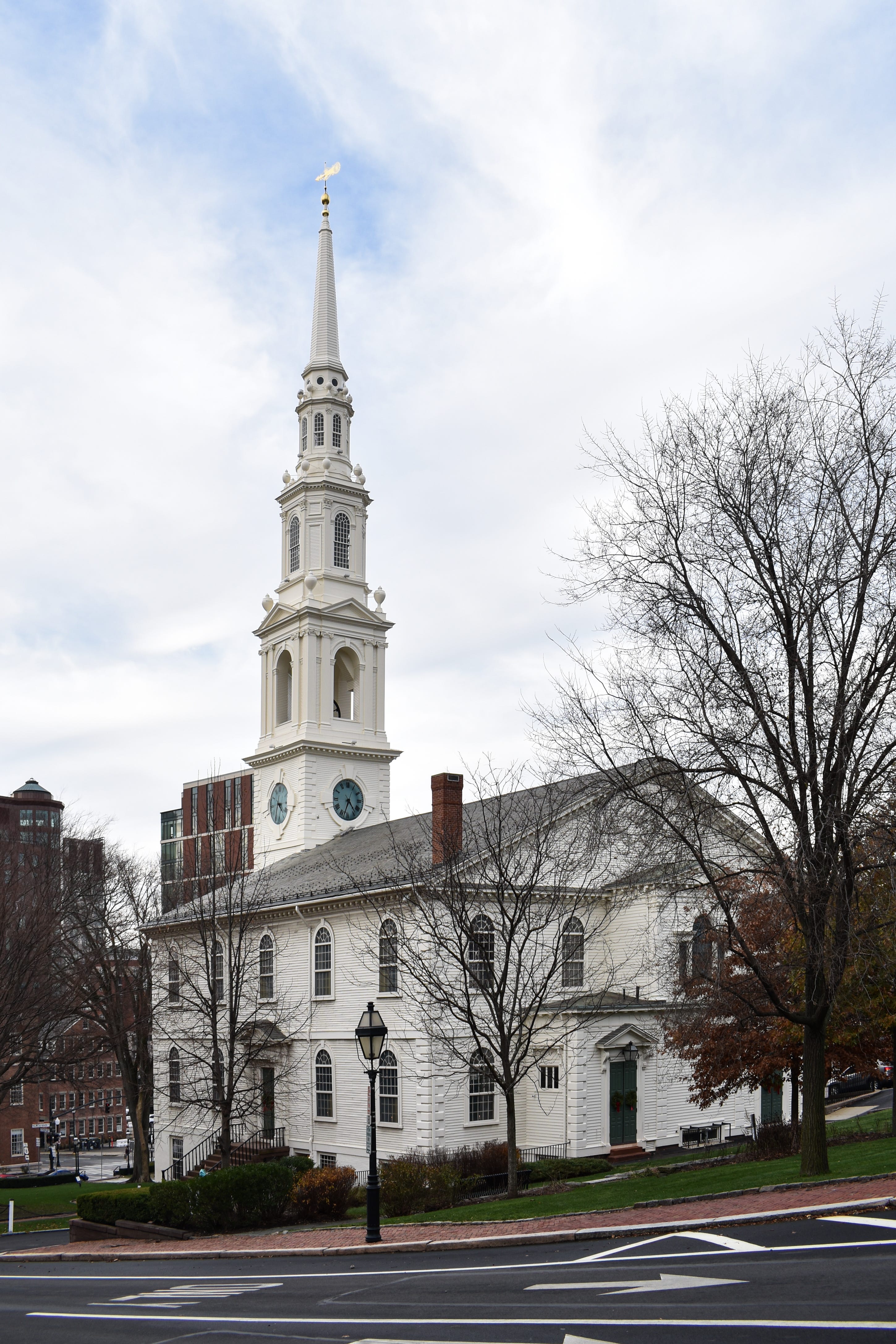
Photo credit: First Baptist Church of Providence, RI (Filetime / Wikipedia)

Further reading on mainline Protestant ministers running for office:
Chris Gehrz, “Pastors as Politicians,” Anxious Bench, January 7, 2021.
Richard Osling, “The Mainline’s Unexpected 2026 Political Comeback,” Religion Unplugged, September 22, 2026.
Jia Lynn Yang, “Can Democrats Reclaim the Christian Moral High Ground?” New York Times, September 21, 2026.
The answer to this question is that the midterms will not do anything to mainline Prots. Not because the goals of these churches and Democrats don’t align, they seem too, but because the relationship is ordered incorrectly. You go to church to meet God, not organized politics. People who come for politics will not stay for God because they are ultimately not interested in God. Once the culture war passes through the mainline will be left with the same dwindling congregation. Faith should inform your politics, but politics should never inform your faith.
Jesus must be shaking his head at what so called "Christianity" has become. You've heard of Joseph Sobran, no doubt.
" I miss the serenity of believing I lived under a good government, wisely designed and benevolent in its operation. But, as St. Paul says, there comes a time to put away childish things."